
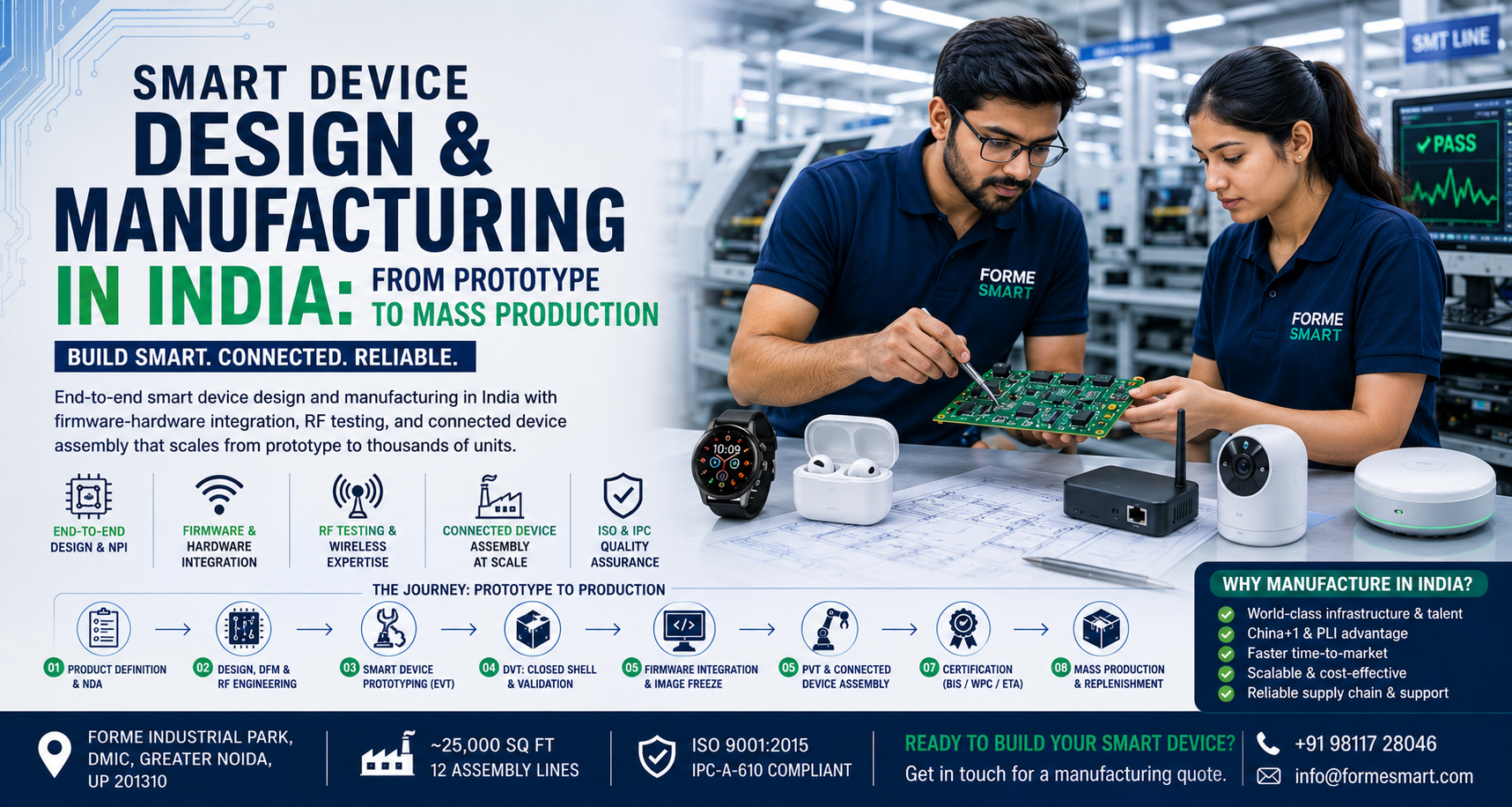
If you're launching a watch, TWS, tracker, or router-adjacent gadget, smart device design and manufacturing India is not "SMT plus a pretty shell." It's radios, firmware, antennas, batteries, and a factory that can do connected device assembly without killing RF. Most brands treat firmware as an app problem and the plant as a metal problem. Then the sample fails BIS.
This guide maps smart device design and manufacturing India from prototype to mass production: IoT device manufacturing realities, firmware and hardware integration, and smart device prototyping. You'll get a staged process, cost/time tables, and the mistakes that stall a launch.
Key Takeaways
- Smart device design and manufacturing India is a hardware-plus-firmware pipeline, not board stuffing with a logo.
- Smart device prototyping should prove radios and battery life, not just power-on.
- Firmware and hardware integration belongs on the line (golden image, hash, rollback), not in a founder's laptop at 2 a.m.
- IoT device manufacturing and connected device assembly need RF-aware fixtures; a generic SMT house will yield pretty bricks.
- Pick a smart devices manufacturer India / smart product manufacturer India plant that can climb EVT→DVT→PVT on the same site.
What Is Smart Device Design and Manufacturing India?
Smart device design and manufacturing India means taking a connected product - wearables, TWS, IoT nodes, CPE - from electrical and industrial design through SMT, firmware load, RF/functional test, and pack-out, inside Indian plants that can also support BIS and local logistics.
That's the direct answer. A smart devices manufacturer India partner may start from your Gerbers or help close custom PCB and antenna work. A smart product manufacturer India label usually implies finished-goods responsibility: cosmetics, charger, carton. IoT device manufacturing is the same family with more sensors and often uglier certifications.
Here's the thing: "smart" is the firmware and the radio. If those aren't in the RFQ, you're buying a dumb assembly job and hoping. Honestly, that's how first lots miss Diwali.
Why Prototype-to-Mass-Production Is Harder for Smart Devices
A toaster doesn't care about BLE coexistence. Smart device design and manufacturing India does. Antenna keep-outs, crystal placement, and battery gauge algorithms show up as "the sample worked on the desk." Connected device assembly in an enclosure detunes everything.
China+1 and PLI make Indian capacity real for phones, watches, TWS, routers, laptops. They don't erase physics. A smart product manufacturer India still needs an RF jig and a firmware station. IoT device manufacturing without a conducted test is a marketplace return generator.
Firmware and hardware integration is the other trap. Version 0.9 on EVT and 1.4 on PVT with no board ID mapping is how you un-debug the field. Smart device prototyping should freeze a protocol, not a vibe.
The Smart Device Path: Prototype to Mass Production
This is the sequence serious programmes follow. Eight gates. A plant that wants to jump from "looks nice" to 10,000 units is selling optimism.
Product definition and NDA
Radios (BLE, Wi-Fi, LTE, GPS), battery life, IP rating, target BIS/wireless. The programme starts with a threat model for the airwaves, not a moodboard. Share files under NDA.
Design: board, RF, mechanics
Stack-up, antenna, enclosure dielectric. IoT device manufacturing fails here when the plastic is chosen for gloss, not RF. DFM should flag that, not wait for tool steel.
Smart device prototyping (EVT)
Smart device prototyping means 10-50 units that exercise firmware and hardware integration: boot, charge, radio, sensors. If it only blinks, it isn't a smart device prototype. Connected device assembly at this stage can still be bench-level.
DVT: the real enclosure
Drop, sweat, RF in the closed shell, audio if TWS. Skip closed-shell RF and you'll discover it in customer reviews. Log detuning; don't argue with the network.
Firmware freeze candidate
Golden image, signing if you have it, rollback plan. Firmware and hardware integration on the line needs a programming fixture that records the hash against the serial. IoT device manufacturing without that is unsupportable.
PVT and connected device assembly
Connected device assembly at rate: torque, adhesives, labels, IMEI/MAC if required. This is where cycle time gets proven. Smart device prototyping fixtures get replaced by production jigs.
Certification samples
BIS, WPC/ETA as applicable. Put certification on the calendar as a real row, not a footnote. Samples must match production firmware.
Mass production and replenishment
Same recipe, incoming QA on batteries and displays, yield tracking. A smart devices manufacturer India who changes the crystal vendor silently is not your friend. IoT device manufacturing at volume is change control. Process visual: smart device design and manufacturing India from smart device prototyping through connected device assembly.
Hardware, Firmware, and the Factory Floor
Firmware and hardware integration is a manufacturing problem. Treat it like one.
Table 1 - Where firmware meets the line
| Stage | Hardware | Firmware | Factory need |
|---|---|---|---|
| EVT smart device prototyping | Dead-bug OK | Debug build | UART, logs |
| DVT | Closed mechanics | Feature complete | RF jig, battery cycle |
| PVT connected device assembly | Frozen BOM | Release candidate | Hash + serial bind |
| MP | AVL locked | Signed image | Traceability, rollback |
Partners who say "you handle firmware" still need a load station. If they don't, you're the programmer sitting on the packing table. Refuse that theatre.
IoT device manufacturing often adds cloud provision - device certs, QR, claim codes. Build that into connected device assembly or you'll relabel 5,000 cartons.
Who You Hire: Smart Devices vs Smart Product vs Full Design-Build
Names get sloppy. Use them with intent when you RFQ a connected-device plant.
Table 2 - Partner types
| Label | Typical scope | Watch-out |
|---|---|---|
| Smart devices manufacturer India | PCBA + device assembly | May skip RF test |
| Smart product manufacturer India | Finished SKU, pack, cosmetics | May push their ODM platform |
| Full smart device design and manufacturing India | Design + NPI + MP | Scope and IP must be written |
| Pure SMT house | Boards only | Weak at connected device assembly |
A smart devices manufacturer India is enough if your ID and RF are done. A smart product manufacturer India is what you want when the carton is part of the SKU. Full smart device design and manufacturing India is the one-roof path - useful, but write who owns the antenna design.
Forme Smart, as a plant on DMIC Greater Noida running watches, TWS, phones, routers, and laptops, sits in the overlap: assembly muscle plus room for IoT device manufacturing-style NPI. Soft sell, not a hymn.
Cost and Timeline Bands (India, Planning)
A connected SKU is costlier than a two-layer blinker because of radios, batteries, and cosmetics.
Table 3 - Order-of-magnitude (ex-GST, 2026)
| Item | Prototype / EVT | Volume (1k-10k) |
|---|---|---|
| PCBA (wearable / TWS class) | ₹1,200-4,500 / board | ₹180-650 |
| Connected device assembly add-on | ₹800-4,000 / unit | ₹200-900 |
| RF / FCT fixtures (NRE) | ₹40,000-2,50,000 | amortised |
| Smart device prototyping lot (20-50) | 2-6 weeks stocked | - |
| DVT + firmware and hardware integration | 4-8 weeks | - |
| First mass lot | 8-14 weeks | after PVT |
Lead times still follow parts. A factory cannot fabricate an allocated SoC. Smart device prototyping with stocked BLE modules is fast; custom SiP is not.
A quick tip: budget a second smart device prototyping spin after enclosure RF. Almost everyone needs it. IoT device manufacturing quotes that assume first-pass RF are lying politely.
Quality: ISO, IPC, and Radios
IPC-A-610 keeps joints honest. ISO 9001 keeps the recipe. The job also needs RF and battery criteria. A plant without a Faraday-ish test corner will ship units that pass AOI and fail a living room.
Firmware and hardware integration bugs look like "hardware" to customer care. Bind versions. Connected device assembly should reject a board that won't take the image.
Make in India doesn't replace that discipline. PLI plants still ship junk if the control plan is a PDF in a drawer.
Radios, Batteries, BIS - The India-Specific Drag
Here's the thing most imported playbooks skip. A connected SKU for India often needs WPC/ETA for the radio and BIS for the product category. Those samples have to match production firmware and the same enclosure dielectric. If you certify a bench unit in ABS and ship a glossy PC blend, you didn't certify the SKU.
Batteries are the other silent calendar. Cells, protection boards, and UN38.3 paperwork don't care that your app is ready. Connected device assembly that stuffs an untested pack into a watch case is how marketplace listings die in week two. Ask for incoming cell data and a charge-discharge log on EVT, not a "battery OK" tick.
Firmware and hardware integration should include a provisioning story: MAC/IMEI, cloud claim, reset. IoT device manufacturing that leaves that to "the software team later" will relabel cartons. Smart device prototyping is the cheap place to find that out.
Logistics help too. A DMIC Greater Noida plant can move NCR samples overnight and still import long-lead SoCs through IEC. That's not romance. It's GST invoices and a dock.
Wearables vs TWS vs Routers on the Same Campus
Not every connected SKU stresses the line the same way. A smartwatch wants a small board, a curved glass or plastic stack, a strap, and a battery that can't bulge. Cycle time is fixture-limited. Cosmetic AQL is brutal because the product sits on a wrist in daylight.
TWS is worse on tiny mechanics: stem torque, charging-case magnets, pairing in the pack. Audio limits belong in the test spec or you will debate "tinny" with a marketplace reviewer. The radio is BLE; the pain is mechanical.
A router or CPE is the opposite. Bigger board, more heat, antenna variety, maybe a SIM. Connected device assembly here is screws, labels, and RJ45 feel - plus RF that has to pass in a living room full of Wi-Fi. IoT device manufacturing for a tracker sits between those extremes: uglier enclosure, nastier certifications, less jewellery.
Forme Smart already runs phones, watches, TWS, routers, and laptops through one Greater Noida campus. That doesn't mean your SKU is a copy-paste. It means the plant has seen the failure modes. You still freeze the recipe. A quick tip: don't let a watch fixture "adapt" to a TWS case. That's how you buy a week of unexplained drop fails.
India's PLI chatter helps capacity. It does not write your work instructions. ISO and IPC keep the joints and the paperwork honest; your RF jig keeps the product honest.
Common Mistakes in Smart Device Design and Manufacturing India
First, enclosure-first industrial design that ignores antenna keep-out. Your smart product manufacturer India will not invent physics.
Second, smart device prototyping that never leaves a bench. Connected device assembly in the real shell is the test.
Third, no owner for firmware and hardware integration. The app team and the SMT team both think the other owns it.
Fourth, hiring a board-only shop and calling them a smart devices manufacturer India. IoT device manufacturing needs more than paste.
Fifth, freezing nothing. Smart device design and manufacturing India at mass production is a copy of PVT - or it's another prototype with a volume invoice.
Avoid these and the factory becomes a ladder, not a lottery.
Content & Structured-Data Schema
This article ships with a Schema.org @graph so search and answer engines can parse prototype-to-mass-production entities.
Schema.org @graph entity relationships embedded in this page (JSON-LD)
Structured-Data Schema Graph
Schema.org @graph entity relationships embedded in this page (JSON-LD)
flowchart TD
  BP["BlogPosting + speakable
Prototype to mass production"]
  WP["WebPage"]
  WS["WebSite
formesmart.com"]
  ORG["Organization
Forme Smart · Greater Noida"]
  IMG["ImageObject
hero 1717×916"]
  HT["HowTo
8 prototype-to-MP steps"]
  FAQ["FAQPage
5 Q&A pairs"]
  BC["BreadcrumbList
Home › Blog › Article"]
  WP -->|isPartOf| WS
  WS -->|publisher| ORG
  BP -->|author / publisher| ORG
  WP -->|mainEntity| BP
  BP -->|image| IMG
  BP -->|describes| HT
  BP -->|answers| FAQ
  WP -->|navigation| BC
Conclusion
Smart device design and manufacturing India is a staged climb: definition, RF-aware design, smart device prototyping, closed-shell DVT, firmware and hardware integration freeze, connected device assembly at PVT, certification, then copy-exact mass production. IoT device manufacturing doesn't skip those rungs because the slide says "agile."
If you need a plant on the DMIC corridor, bring the radio spec and the golden image. Forme Smart can run the line. You still own the product decisions.
Ready to Go From Prototype to Mass Production?
Forme Smart supports smart device design and manufacturing India work at Forme Industrial Park, DMIC, Greater Noida, UP 201310 - ~25,000 sq ft, 12 assembly lines, ISO and IPC-aligned processes for phones, smartwatches, TWS, routers, laptops, and EV 2-wheeler electronics.
Get In Touch Today Call +91 98117 28046Get In Touch - +91 98117 28046 or info@formesmart.com - request a manufacturing quote.
Frequently Asked Questions
What does smart device design and manufacturing India include?
Smart device design and manufacturing India typically covers board/RF/mechanical design (or DFM), SMT, firmware load, RF/functional test, and connected device assembly through pack-out. Confirm whether your smart devices manufacturer India quote is PCBA-only or a finished SKU.
How is smart device prototyping different from a normal PCBA sample?
Smart device prototyping must exercise radios, battery, and firmware and hardware integration - not just 3.3 V on a rail. A smart product manufacturer India should treat EVT as a learning lot, not a photo prop. IoT device manufacturing samples that only blink are not done.
Why is firmware and hardware integration a factory issue?
Because the image must be loaded, hashed, and traced to a serial on the line. Firmware and hardware integration that lives only on a founder's laptop will not survive connected device assembly at volume. Ask the plant to show the programming station.
How long from prototype to mass production?
With stocked parts, smart device prototyping can be weeks; a full smart device design and manufacturing India climb through DVT, PVT, and certification is often a quarter or more. Anyone promising 10,000 shippable units in four weeks is ignoring BIS or the BOM.
Can Forme Smart handle IoT device manufacturing and connected device assembly?
Yes. Forme Smart runs IoT device manufacturing-adjacent consumer devices and connected device assembly at Greater Noida. Start with NDA and a radio spec - +91 98117 28046.